
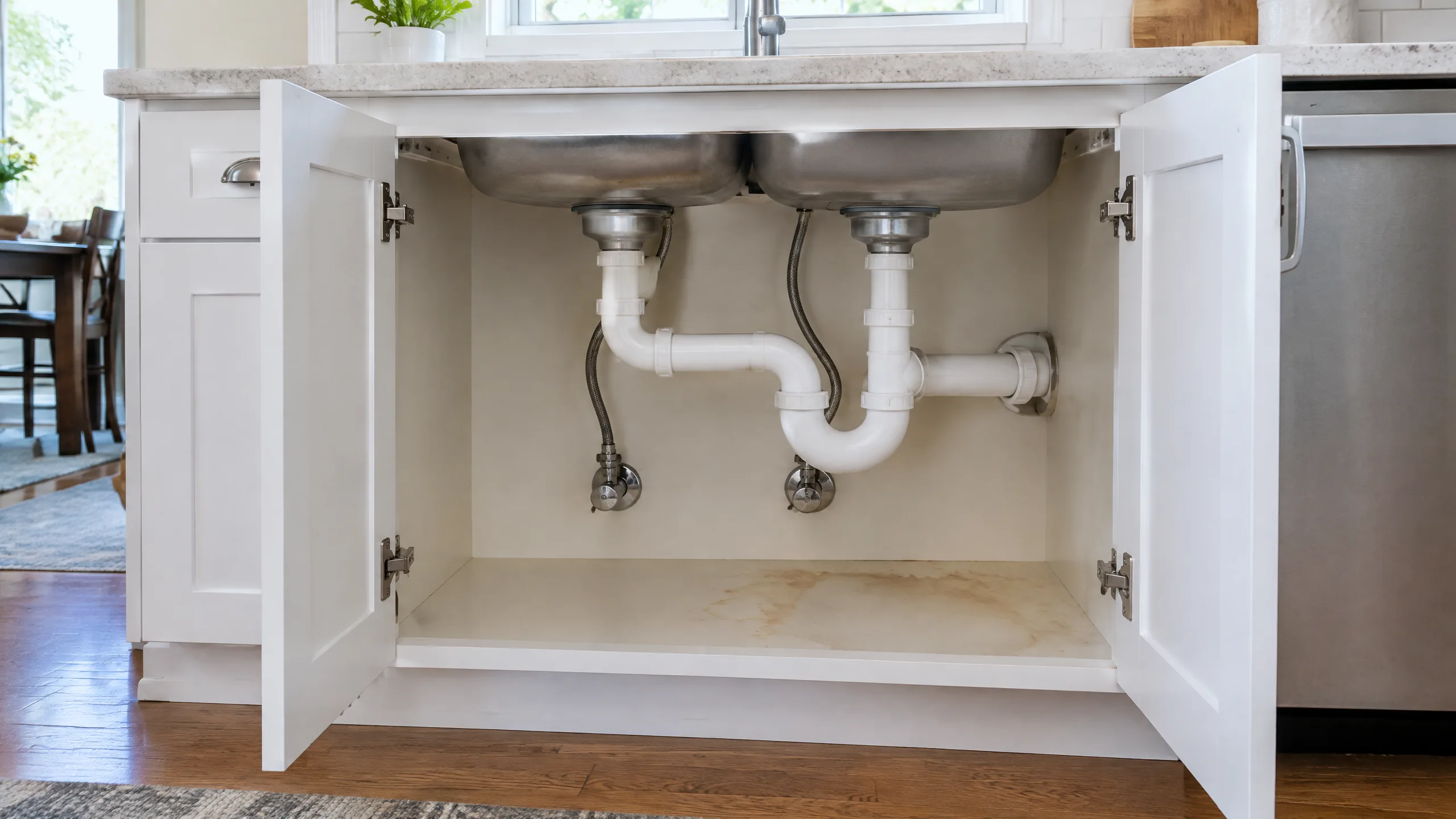
An open sink cabinet offers a view of plumbing. During a Fort Mitchell home inspection, visible evidence, accessible connections, and fixture operation help distinguish a present condition from a clue about an earlier event.
Begin with what the cabinet shows
A cabinet base may show discoloration, swelling, a roughened edge, or a repair. Those clues do not establish when moisture arrived or whether it continues. A dry old mark differs from damp material or fresh pooling at a connection.
Stored cleaners, liners, and household items can hide portions of the floor and plumbing. Accessible, visible conditions are the basis for a whole-home inspection, so an obstruction or a closed access area can limit what can be seen. That limit matters as much as an observation because it keeps the report tied to the conditions available on inspection day.
Follow the accessible supply side
Under a kitchen or bathroom sink, visible supply tubes, shutoff valves, faucet connections, and nearby surfaces give context. During normal fixture operation, attention can turn to obvious dripping, moisture, residue, or water collecting where it should not. A visible issue at one connection does not identify the cause of every mark in the cabinet.
A quiet moment is not a promise. A connection may be dry during a visual visit even though a condition is intermittent, concealed, or outside the accessible area. Five Star’s service scope explains that an inspection cannot reveal every concealed or future condition.
Read the drain assembly in context
The drain side often includes a sink strainer, tailpiece, trap, trap arm, and visible joints. When a sink is operated, functional drainage and the accessible area beneath it can offer information about that moment. The InterNACHI Standards of Practice describe a home inspection as a non-invasive visual examination of accessible areas and call for reporting observed active plumbing water leaks.
A stain is evidence, not a diagnosis
A stain near a drain joint may be historic, may relate to an event elsewhere, or may warrant attention if current moisture is also visible. A home inspector can document observable conditions and recommend further evaluation. Determining a concealed source, taking components apart, or providing a repair design is outside a standard visual inspection.
Distinguish active moisture from history
Clear descriptions make a practical difference: dry staining, damp material, active dripping, pooling water, and inaccessible areas are not interchangeable. This approach helps a reader understand both what was seen and what was not established. It also avoids treating a cabinet that appears dry as proof that the plumbing will remain leak-free.
If a question extends beyond the cabinet, broader moisture context can be helpful. Our related article on laundry-room moisture questions explains why plumbing leaks, condensation, and dryer exhaust should be considered as separate possibilities rather than assigned from a stain alone.
Use follow-up questions that fit the evidence
For a past mark with no active moisture observed, useful questions include whether there are records of prior work, whether the cabinet was repaired, and whether the seller has relevant disclosure information. For active moisture or a concerning accessible connection, a qualified plumbing professional can diagnose the source and advise on repair. That is more useful than assuming a price, a timeline, or a hidden condition from one clue.
- What was visible and accessible beneath the sink?
- Was moisture observed while the fixture was operating?
- What conditions limited the view?
- What record or specialist question would clarify the next step?
For a separate household check, the EPA notes that a water meter that changes over two hours when no water is being used probably indicates a leak. That result does not locate the source, but it can be a reason to investigate further.
Put plumbing observations to work
The value of an inspection note is clarity about the property, not a prediction about every pipe behind a wall. If findings raise several property questions, see how to separate property questions from transaction decisions. For future ownership planning, a useful maintenance handoff can help organize service records and system details.
Five Star Home Inspections reviews visible, accessible plumbing components during a Fort Mitchell home inspection. To share property details, schedule an inspection. Use the report with relevant records and qualified tradespeople when additional evaluation is needed; focused specialist follow-up can make those conversations specific.